


Your child is seven, still losing baby teeth, and someone mentioned an orthodontist. That feels early. You may be wondering if you missed a window, or if braces are coming next week.
Most children who get checked at age 7 do not need treatment yet. The American Association of Orthodontists recommends a first orthodontic checkup by age 7, when a child has a mix of baby and permanent teeth. That visit is a screening, not a commitment to braces. It gives the orthodontist a baseline to watch growth and step in only if timing matters.
Dr. Thomas Jaeger, DDS, holds a Certificate of Orthodontics from Oregon Health Science University and has treated more than 10,000 patients in Northern Idaho since 1986. That long view matters here, because Phase One is as much about knowing when to wait as when to act. Parents in Coeur d’Alene ask us this constantly, so here is the plain answer, backed by what the research actually says.
Key takeaways for parents
- The AAO recommends a first orthodontic checkup by age 7, whether or not you see a problem.
- Phase One treatment usually happens between ages 6 and 10, while the jaw is still growing.
- Most children screened at 7 need no treatment yet, just monitoring as they grow.
- Phase One, when needed, often runs 6 to 18 months and targets one specific issue.
- Book a screening if you notice crowding, a crossbite, thumb-sucking past age 5, or mouth breathing.
What is Phase One orthodontics?
Phase One orthodontics is early treatment for children roughly ages 6 to 10, while they still have a mix of baby and permanent teeth. It is also called interceptive orthodontics. The goal is not a straight smile yet. The goal is to guide jaw growth and make room for adult teeth, so later treatment is simpler or shorter.
Phase One works with growth rather than against it. At this age, the bones of the jaw and palate are still soft and shifting. An orthodontist can widen a narrow upper jaw or correct a crossbite while the body is doing the heavy lifting on its own. Wait too long, and some of these corrections need surgery instead.
This is different from full braces. Phase One often uses a single appliance, such as a palatal expander, or braces on just a few teeth. It targets one clear problem. It does not try to align every tooth. That work, if it is needed at all, comes later in Phase Two.
Why does age 7 matter so much?
Age 7 is the checkpoint, not the start line for braces. By this age, a child’s first permanent molars and front teeth have usually come in, so an orthodontist can see how the bite and jaw are developing. Enough is visible to catch a real problem early, while there is still years of growth left to work with.
The number comes straight from the American Association of Orthodontists. The AAO runs a national campaign encouraging parents to bring children in by age 7. The reasoning is practical. A narrow jaw or a crossbite spotted at 7 is far easier to guide than the same problem found at 14, after growth has slowed.
If your child is younger than 7 and something looks off, you do not have to wait. The AAO is clear that any age is the right age to come in the moment you notice an issue. A thumb-sucking habit or an obvious underbite at age 5 is worth a look now, not two years from now.
Does an early visit mean my child needs braces?
Usually not. Most children who come in for a first checkup at 7 leave with a monitoring plan, not an appliance. The visit confirms that growth is on track, or flags something to watch. Only a portion of children need active Phase One treatment, and a good orthodontist will tell you plainly when waiting is the better call.
This is the single biggest worry we hear from parents in Coeur d’Alene. Bringing a second-grader to an orthodontist does not mean braces on that day. It means someone with training is now watching your child’s growth, so nothing gets missed.
Here is the honest part. Early treatment is only worth doing when it prevents a bigger problem. If Phase One will not change the outcome, the right answer is to wait and monitor. Dr. Jaeger’s approach is to recommend early treatment only when it genuinely saves your child from more invasive care later.
Signs your child may need early treatment
Not every child needs Phase One, but some signs point to an evaluation sooner rather than later. Watch for these while your child is still in the mixed-teeth years. Any one of them is a reason to book a screening, not a reason to panic.
- Crowded or overlapping teeth as adult teeth start to come in
- A crossbite, underbite, or noticeably protruding front teeth
- Baby teeth lost much earlier or later than expected
- Thumb-sucking or mouth breathing that continues past age 5
- Difficulty chewing, or a jaw that shifts or clicks
- Speech trouble that seems linked to tooth or jaw position
These are the patterns orthodontists look for, and they line up with the warning signs the AAO lists for parents. If you spot one, an evaluation can confirm whether treatment helps or whether monitoring is enough.
Airway and breathing deserve a closer look. A narrow upper jaw can crowd both teeth and the airway, and mouth breathing at night is a common flag. Jaeger Orthodontics treats jaw development and airway health together, which matters for a child who snores or breathes through the mouth while sleeping.
What appliances does Phase One use?
Phase One relies on simple appliances that guide growth, not a full set of braces. The exact tool depends on the problem. A palatal expander widens a narrow upper jaw. Braces on a few front teeth correct a specific alignment issue. A space maintainer holds a gap open after a baby tooth is lost too soon.
The palatal expander is the workhorse of early treatment. It gently widens the upper jaw by stretching the growth plate in the roof of the mouth, which stays flexible until roughly ages 12 to 14. Used during active growth, it creates room for crowded teeth and can improve both bite and breathing.
Modern tools make this easier on a child than parents expect. Digital scanners replace the messy molds many adults remember. Appliances are smaller now. Most children adjust within a week or two, once the newness wears off.
Most Phase One treatment runs about 6 to 18 months, with a check-in every few weeks. After that, your child enters a resting period. The remaining permanent teeth finish coming in naturally, and the orthodontist watches to see whether Phase Two is needed at all.
What happens after Phase One?
After Phase One, most children take a break from active treatment. This resting period lets the rest of the permanent teeth erupt on their own. The orthodontist checks in periodically, usually at no cost, to track how the smile is settling.
Around ages 11 to 13, the orthodontist decides whether Phase Two is needed. Phase Two is comprehensive treatment, the braces or clear aligners most people picture, once all the adult teeth are in. Because Phase One already handled the jaw and spacing, Phase Two is often shorter and more straightforward.
Some children skip Phase Two entirely. Others need a full round to finish alignment. The point of the two-phase approach is not more treatment, but better-timed treatment. Fixing the foundation early can make the second stage easier, and sometimes unnecessary.
For a lot of families, the resting period is the reassuring part. There is no appliance to track. No adjustment visits, just a check every so often. Your child gets to be a kid. The orthodontist keeps a quiet eye on how the adult teeth arrive.
Getting your child evaluated in Coeur d’Alene
The best way to know if your child needs Phase One is a simple screening, and age 7 is the moment to schedule it. A first visit at Jaeger Orthodontics covers jaw growth, spacing, bite, and how the permanent teeth are coming in. Many children leave with nothing more than a plan to check back as they grow.
Cost is a fair question, and it varies by what your child actually needs. Phase One is usually shorter and more focused than full braces, so it often costs less than comprehensive treatment. Jaeger Orthodontics reviews payment plans and helps with insurance claims before any treatment starts, so you know the numbers ahead of time. Ask about combined Phase One and Phase Two pricing during the consultation.
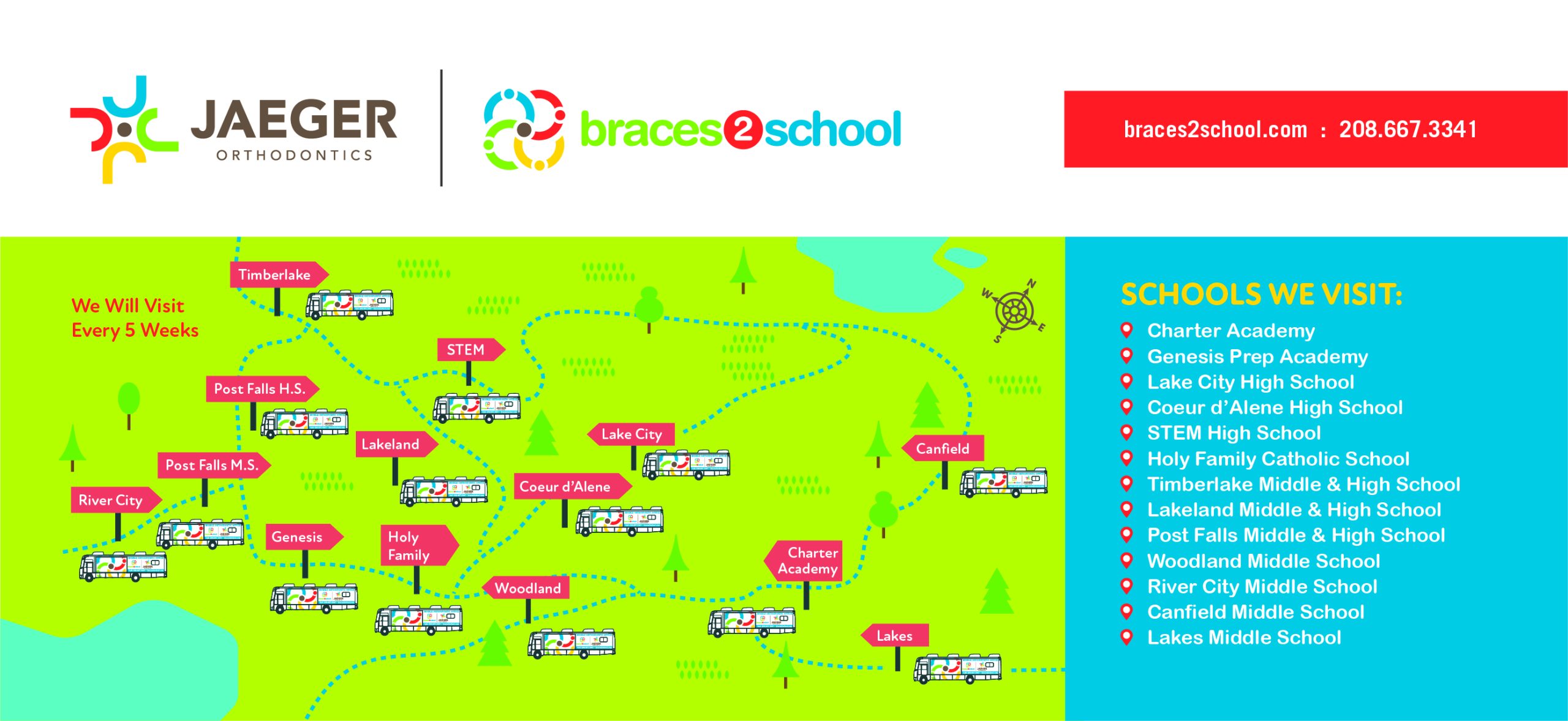
Jaeger Orthodontics serves families across Coeur d’Alene and Northern Idaho, with offices in Coeur d’Alene, St. Maries, and Kellogg, plus the Braces2School mobile unit. To book your child’s screening, call Jaeger Orthodontics at (208) 667-3341 or request an appointment online. Dr. Thomas Jaeger, DDS, Orthodontist Coeur d’Alene, will give you an honest read on whether early treatment helps your child, or whether waiting is the smarter move.